Risk Management Tools
Aviation safety managers face the daunting task of ensuring operational safety in an industry where risks can have catastrophic consequences. Effective risk management tools are critical for identifying, assessing, and mitigating potential hazards. Among these tools, Bow-Tie Analysis stands out as a powerful, visual, and structured approach to managing risks in aviation.
This article explores the Bow-Tie Analysis methodology, its application in aviation, and how safety managers can leverage it to enhance safety protocols and compliance.
What Is Bow-Tie Analysis?
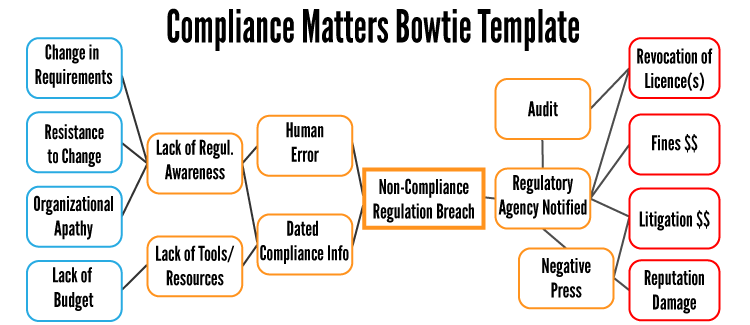
Bow-Tie Analysis is a risk assessment tool that provides a clear, visual representation of risk scenarios. Named for its distinctive bow-tie shape, the diagram maps out the relationships between potential hazards, their causes, consequences, and the controls in place to prevent or mitigate them. The methodology is widely used in high-risk industries like aviation, oil and gas, and healthcare to manage complex risks effectively.
Related Bowtie Analysis in Aviation SMS Articles
- What, Why, and How to Use Bowtie Analysis in Aviation SMS
- How to Do Bowtie Analysis in Aviation SMS – 5 Step Walkthrough
- 6 Essential Rules for Bowtie Analysis in Aviation SMS
Components of a Bow-Tie Diagram
A Bow-Tie diagram is divided into several key components:
- Hazard: The potential source of harm (e.g., an aircraft engine failure).
- Top Event: The critical moment when control is lost, leading to a potential incident (e.g., loss of engine power during flight).
- Threats: Factors that could cause the top event (e.g., mechanical failure, human error, or environmental conditions).
- Consequences: The potential outcomes of the top event (e.g., emergency landing, crash, or injury).
- Preventive Controls: Measures to stop the top event from occurring (e.g., regular maintenance checks, pilot training).
- Mitigative Controls: Actions to reduce the severity of consequences if the top event occurs (e.g., emergency procedures, redundancies).
The left side of the diagram focuses on preventing the top event, while the right side addresses mitigating its consequences, creating a balanced approach to risk management.
Why Bow-Tie Analysis Is Essential for Aviation Safety
Aviation is inherently complex, with multiple
- stakeholders,
- regulatory requirements, and
- operational variables.
Bow-Tie Analysis offers several advantages for safety managers:
- Clarity and Communication: The visual nature of the Bow-Tie diagram simplifies complex risk scenarios, making it easier to communicate risks to stakeholders, including pilots, maintenance crews, and regulators.
- Comprehensive Risk Identification: It ensures all threats and consequences are systematically identified, reducing the likelihood of overlooking critical risks.
- Proactive and Reactive Strategies: The methodology balances preventive and mitigative controls, fostering a holistic approach to safety.
- Regulatory Compliance: Bow-Tie Analysis aligns with standards like those from the International Civil Aviation Organization (ICAO) and the Federal Aviation Administration (FAA), supporting compliance efforts.
- Continuous Improvement: By identifying gaps in controls, safety managers can refine processes and enhance safety protocols.
Related Bowtie Analysis in Aviation SMS Articles
- 3 Ways You’re Not Using the Bowtie in Aviation SMS
- 4 Best Uses of Bowtie Method in SMS Risk Management – Do You Use Them?
- Difference Between Reactive, Proactive and Predictive Risk Management in Aviation SMS
Applying Bow-Tie Analysis in Aviation

To illustrate how Bow-Tie Analysis works in aviation, let’s consider a common scenario: runway incursion, where an unauthorized aircraft, vehicle, or person enters the runway, risking a collision.
Step 1: Identify the Hazard and Top Event
- Hazard: Runway operations.
- Top Event: Runway incursion occurs, leading to a potential collision.
Step 2: Map Threats
Threats that could lead to a runway incursion include:
- Miscommunication between air traffic control (ATC) and pilots.
- Pilot error, such as misunderstanding taxi instructions.
- Ground vehicle operator error.
- Poor visibility due to weather conditions.
Step 3: Identify Consequences
If a runway incursion occurs, consequences might include:
- Near-miss incident.
- Collision resulting in damage, injury, or fatalities.
- Operational delays and reputational damage.
Step 4: Define Preventive Controls
Preventive controls aim to stop the incursion from happening:
- Training: Regular training for pilots, ATC, and ground crews on communication protocols.
- Technology: Ground radar systems and runway incursion warning systems.
- Procedures: Standardized taxiway and runway signage, clear ATC instructions.
- Visibility Aids: Enhanced lighting and markings for low-visibility conditions.
Step 5: Define Mitigative Controls
Mitigative controls reduce the impact if an incursion occurs:
- Emergency Protocols: Rapid response procedures for ATC to halt operations.
- Collision Avoidance Systems: Aircraft equipped with Traffic Collision Avoidance Systems (TCAS).
- Incident Reporting: Robust reporting systems to analyze and learn from near-misses.
Step 6: Construct the Bow-Tie Diagram
Using software tools like BowTieXP, SMS Pro, or even simple diagramming tools, safety managers can create a visual diagram. The diagram centralizes the top event, with threats and preventive controls on the left and consequences and mitigative controls on the right.
Step 7: Analyze and Refine
Once the diagram is complete, safety managers should:
- Assess the effectiveness of existing controls.
- Identify gaps or weaknesses (e.g., outdated training programs).
- Implement improvements, such as new technologies or revised procedures.
- Regularly review and update the Bow-Tie diagram to reflect operational changes.
Benefits of Bow-Tie Analysis in Aviation Safety Management

Implementing Bow-Tie Analysis offers tangible benefits for aviation safety managers:
- Enhanced Decision-Making: By visualizing risks and controls, managers can prioritize resources for maximum safety impact.
- Stakeholder Engagement: The clear format fosters collaboration among teams, ensuring everyone understands their role in safety.
- Incident Prevention: Proactive identification of threats reduces the likelihood of incidents.
- Post-Incident Learning: After an incident, Bow-Tie Analysis helps identify control failures and improve future responses.
Related Aviation Risk Control Articles
- Difference Between Hazards, Risks & Control Measures in Aviation SMS
- What Is a Risk Control in Aviation SMS: Meaning, Purpose, Application
- 5 Tips Reviewing Hazards, Risks & Controls in Aviation SMS - With Examples
Challenges and Best Practices
While Bow-Tie Analysis is highly effective, it comes with challenges:
- Complexity: Creating detailed diagrams for every risk can be time-consuming.
- Data Dependency: Accurate analysis requires reliable data on threats and controls.
- Presentation Limitations: Difficult to present element details, like historical ownership, reviews, related hazards.
- Engagement: Ensuring all stakeholders actively participate in the process can be difficult.
To overcome these challenges, safety managers should:
- Start with high-priority risks, such as runway incursions or engine failures, before expanding to other areas.
- Use software tools to streamline diagram creation and updates.
- Involve cross-functional teams to ensure comprehensive input.
- Integrate Bow-Tie Analysis into existing Safety Management Systems (SMS) for consistency, like SMS Pro's Proactive Hazard Analysis Tool (PHAT).
Integrating Bow-Tie Analysis With Safety Management Systems
Bow-Tie Analysis complements aviation Safety Management Systems (SMS), which are mandated by ICAO and other regulatory bodies. By embedding Bow-Tie diagrams into SMS processes, safety managers can:
- Enhance hazard identification and risk assessment.
- Offer visual hazard-relationship presentations to visual learners.
- Align controls with SMS pillars (safety policy, risk management, assurance, and promotion).
- Provide auditable evidence of risk management for regulatory inspections.
For example, a Bow-Tie diagram for runway incursions can feed into SMS hazard risk registers, informing safety performance indicators and audits.
Tools and Resources for Bow-Tie Analysis
Several tools can assist safety managers in implementing Bow-Tie Analysis:
- BowTieXP: A dedicated software for creating and analyzing Bow-Tie diagrams.
- ReliaSoft: Offers risk analysis modules compatible with Bow-Tie methodology.
- Microsoft Visio: A general diagramming tool for manual Bow-Tie creation.
- SMS Pro: Add-on module integrating with Hazard Register provides basic diagrams and is a cost-effective option.
Additionally, safety managers can access training from organizations like the International Air Transport Association (IATA) or consult ICAO’s Safety Management Manual for guidance.
Related Aviation Safety Software Articles
- How to Perform Risk Assessments without Aviation Risk Management Software
- 20 Benefits of Aviation SMS Software
- How to Choose the Best Aviation Safety Database Software
Conclusion
Bow-Tie Analysis is a game-changer for aviation safety managers, offering a structured, visual, and collaborative approach to risk management. By mapping out hazards, threats, consequences, and controls, safety managers can
- proactively prevent incidents,
- mitigate risks, and
- ensure compliance with regulatory standards.
Whether addressing runway incursions, engine failures, or human errors, Bow-Tie Analysis empowers aviation professionals to build safer skies.
To get started, safety managers should identify a high-priority risk, gather stakeholder input, and create their first Bow-Tie diagram. With practice and integration into SMS, this tool can transform aviation safety management, protecting lives and operations alike.
Call to Action
Ready to enhance your aviation safety protocols? Start implementing Bow-Tie Analysis today. Explore tools like SMS Pro's Bowtie add-on module or BowTieXP, train your team, and integrate this methodology into your Safety Management System for a safer, more resilient operation.